
Feeding
To thrive and grow, babies with cleft lip and palate must be able to successfully feed. It is difficult to create the suction needed to pull milk from a bottle or to latch onto the breast when breastfeeding because of this opening in the palate. As a result, babies with cleft palates may not gain enough weight because feeding takes a lot of energy. It is important for babies to be able to feed comfortably within a reasonable amount of time, without struggling to breathe, choking, or straining to get the milk from the bottle. The feeding goal is to help the baby get the right amount of milk in the right amount of time, and to avoid taking in too much air.
Scope of Services:
- Psychological support to parents and family members.
- Feeding techniques – Spoon feeding, Breast feeding, Bottle feeding, Paaladai and Nifty cup feeding, Long nipple bottle feed, X-cut nipple.
- Positioning and Feeding Techniques for babies with Pierre robin syndrome.
- Weight gain tracking of children with cleft.
- Pre operative and Post operative care and feeding counseling.
- In person and tele Followup of pre and post operative children
Working Days and Hours :
Monday to Saturday, 9AM – 4PM
The role of the Feeding Nurse is to
- Provide Psychological support to the caregivers and family members.
- Provision of Feeding tools and educating the different feeding techniques – Spoon feeding, Breast feeding, Bottle feeding, Paaladai, Nifty cup feeding, Long nipple bottle feed and using X-cut nipple.
- Positioning and Feeding Techniques for babies with Pierre robin syndrome.
- Weight gain tracking of children with cleft.
- Pre operative and Post operative care and feeding counseling.
- In person and tele Followup of pre and post operative children
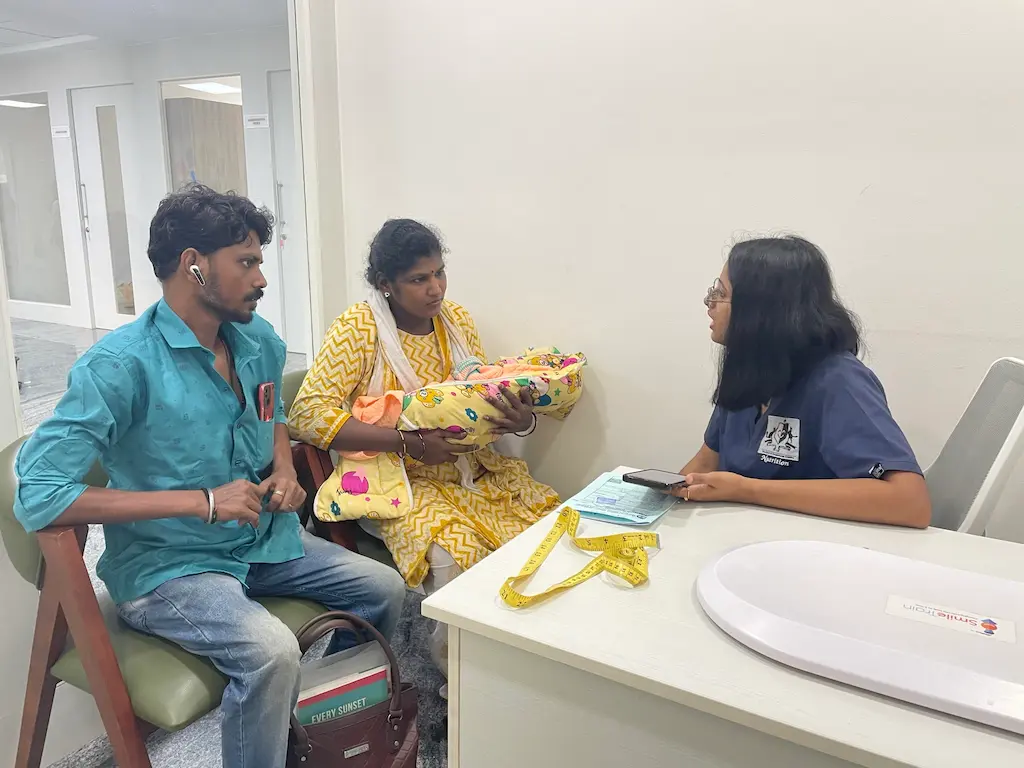
Nutrition
An infant born with a cleft lip / palate may have feeding difficulties and has an increased risk of being Malnourished. Nutrition is essential for optimum growth and development. The first 1000 days of life (From conception up to 2 years of age) is the most critical period for good physical and mental development. Nearly 30% of malnutrition is due to inappropriate feeding practices. Poor nutrition can also increase the risk of infections and it contributes directly/indirectly to 35% deaths in children under five years of age, which is why it is important to provide adequate nourishment to children with cleft lip/palate.
Scope of Services:
- Assessment of Babies born with cleft lip & palate.
- Nutrition Counselling for Parents during Pregnancy and Lactation.
- Educating the mothers on the importance of breastfeeding, importance of Hygiene and Sanitation and basic infant care.
- To emphasize the parents on Feeding position, duration, and the measures to be taken care of.
- To counsel the caregivers to initiate age-appropriate complementary feeding for babies after 6 months of age.
- Nutrition Screening and Assessment of children with cleft lip/palate.
- Nutrition Counselling to caregivers
- Nutrition Education
Working Days and Hours :
Monday to Saturday, 9AM – 4PM
Description :
- The first 1000 days of life (From conception up to 2 years of age) is the most critical period for good physical and mental development. Nutrition plays a very important role for optimum growth and development.
- A newborn should be initiated breastfeeding within 1 hour of birth as per the WHO & UNICEF Recommendations and exclusively breastfeed the child up to 6 months of age. Infants are fed every 2 hours once/ 24 hours. Newborns take about 20-30 minutes for every feed.
- An infant born with a cleft lip / palate may have feeding difficulties, which include ineffective sucking due to inability in generating adequate negative pressure in the oral cavity causing milk regurgitation through the nasal cavity and choking as a result of incomplete facial and structural defects in palate causing low food intake. As a result, the nutritional status of children with clefts becomes poor and has an increased risk of being malnourished. Nearly 30% of malnutrition is due to inappropriate feeding practices.
- Poor nutrition can also increase the risk of infections and it contributes directly/indirectly to 35% deaths in children under five years of age, which is why it is important to provide adequate nourishment to children with cleft lip/palate. Moreover, these problems can have adverse impacts on children’s growth and development.
The role of the nutritionist is to
- Empower caregivers on basic infant care
- Enlightening the caregivers on the importance of the first 1000 days of life.
- Educate on the importance of breastfeeding and complementary feeds for the child. If the breastmilk is not available/insufficient, then infant formula feeds can be given.
- Emphasize on the importance of Hygiene and Sanitation.
- To assess the dietary intake of the child to meet the requirements.
- To monitor the growth of the child and assess the nutritional status.
- To initiate complementary foods to the child and expose them to all the different food groups.
- To create healthy snacking habits and lunch-box ideas for school going children.
Working Days and Hours :
Monday to Saturday, 9AM – 4PM